5-7 yrs
Waiting for the grid
New data centers can wait five to seven years for a grid connection. AI companies need capacity this year.
We're building sealed pods of AI chips that sit on the seabed off Miami and run on the ocean current flowing past, day and night. No grid connection. No land. No fresh water.
No grid. No land. No water.
of continuous NOAA measurements show a remarkably stable current
average flow at 50 m off Fort Lauderdale, every hour of the year
the failures: sealed servers on the seabed versus servers on land
current power, day and night, forecastable a season ahead
Demand for AI computing is growing exponentially. The bottleneck is no longer chips or software. It is electricity, land and permission to build.
New data centers can wait five to seven years for a grid connection. AI companies need capacity this year.
More than a thousand US communities moved to curb AI infrastructure in 2026, over power bills, land and water.
At least 47 large data center projects were delayed, withdrawn or blocked in 2026 alone.
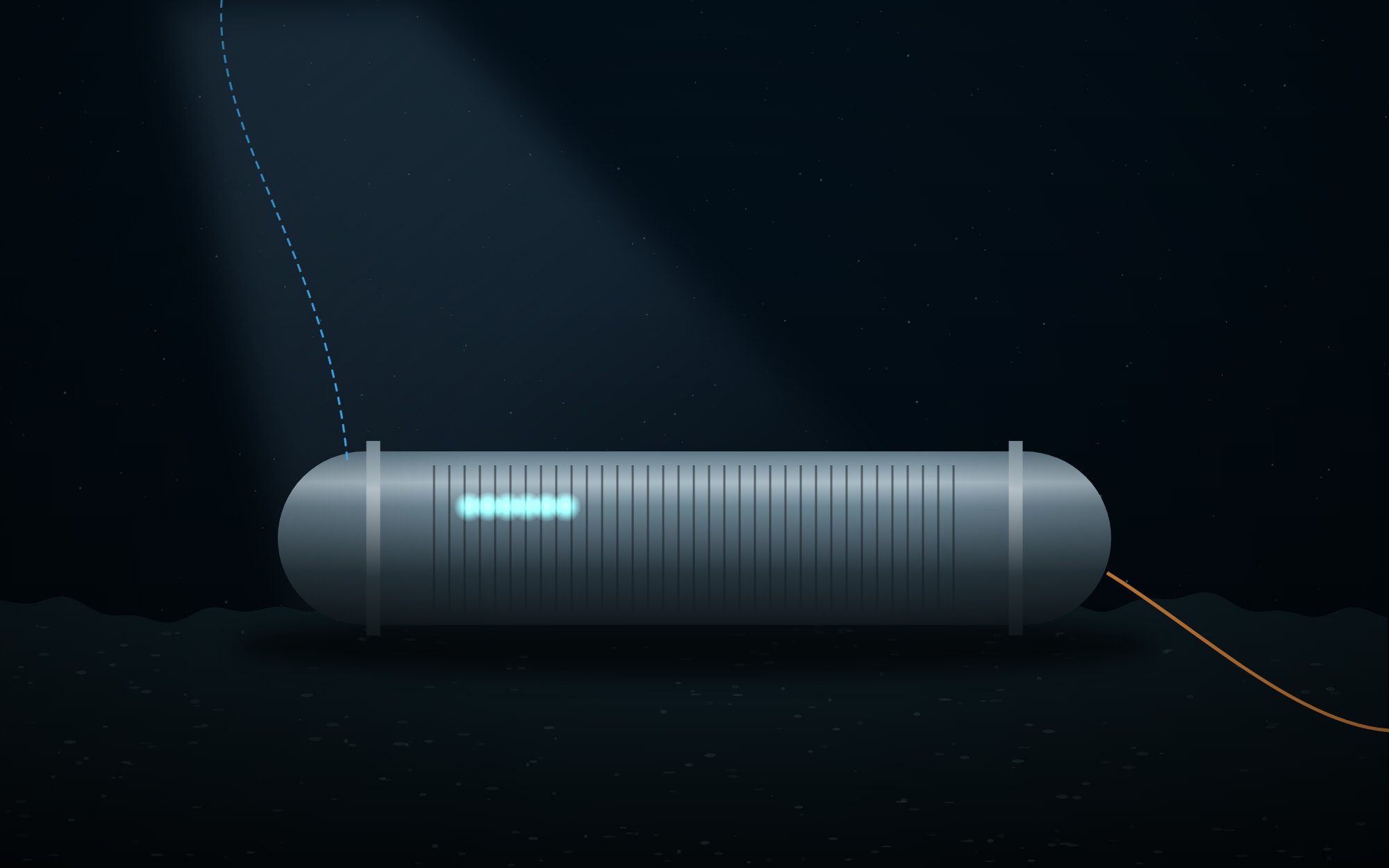
The Gulf Stream flows north a few miles off South Florida at about 1.5 m/s, day and night.
Proven tethered generators fly figure-eights through the current and send power down their tethers to the seabed.
AI chips sit in a sealed steel vessel filled with dry nitrogen. Seawater flowing past the wall carries their heat away.
A data-only fiber rises to a small buoy with Starlink. AI results are tiny, so they travel cheaply; electricity never has to reach shore.
One-eighth the failures. Microsoft sealed 855 servers in a nitrogen-filled pod and left it on the seabed off Scotland for two years. Only 6 failed, against 8 of 135 identical servers kept on land: one-eighth the failure rate.
Dry nitrogen instead of oxygen and humidity.
Nobody bumps, unplugs or mis-handles the equipment.
Cold, constant water and no vibration. The pod never moves.
No chillers or cooling towers. The ocean does the work.
NOAA has measured the Florida Current with a submarine cable since 1982 and found it remarkably stable. Its year-to-year swings follow El Niño with about a three-month lead, so we can forecast each node's output a season ahead. No wind or solar farm can offer that.
Solar stops at night and wind drops. The Gulf Stream runs around the clock, which will make our nodes one of the few ways to run AI on clean power every hour.
No gas turbines, no diesel backup, no fresh water for cooling and no land. We will publish a full lifecycle carbon figure and open monitoring data on marine life from our first deployment, rather than claim zero emissions.
AI's bottleneck is power, not chips. Here is why the answer might be a steel cylinder sitting in the Gulf Stream.
Read the post →Former LIFFE floor trader and early Betfair API developer who has built trading, marketing and AI products. Leads strategy, partnerships, funding and Deeprun's software.
25 years building and repairing complex mechanical systems, and at home on boats. Builds the pods and runs everything at sea.
We are recruiting advisors in subsea engineering and power electronics. Get in touch.
Close, but not quite. Microsoft's Natick project proved that sealed servers last longer on the seabed, but it was plugged into the shore grid. Our pods make their own power from the Gulf Stream and need no grid at all. We call it seabed compute.
Because the grid can't keep up. A node at sea needs no grid connection, no land, no fresh water and no local zoning fight, so capacity can come online years sooner.
Each pod carries spare chips and is built to be lifted and swapped. We plan to bring a pod up only for its chip refresh, about every five years, lowering a fresh pod in its place so the node keeps earning.
The pod and the generators' anchors sit on the seabed, well below storm waves. Only the small surface buoy is exposed, and it is designed to break away and be recovered.
For inference, yes. AI agents run long tasks that tolerate the fraction of a second a satellite link adds, and the results are tiny. At fleet scale, nodes can share a fiber cable to shore.
We survey every site to avoid coral and sensitive habitat, and we will publish monitoring data from our first deployment onward, including the small amount of heat our pods add to the current.
AI agent and app companies, AI labs, GPU clouds and marketplaces. We will sell capacity by the hour on contracts and by the token on model marketplaces, starting with our first commercial node.
Writing about us, introducing us, or explaining us to a colleague? Use these.
AI compute, powered by the Gulf Stream.
We're putting AI chips on the seabed off Miami and running them on the Gulf Stream.
Seabed compute.
We're building our first pod now, and our first commercial node is planned for 2028. Join the early-access list to get first call on capacity and help shape what we build, or talk to us about partnering.